
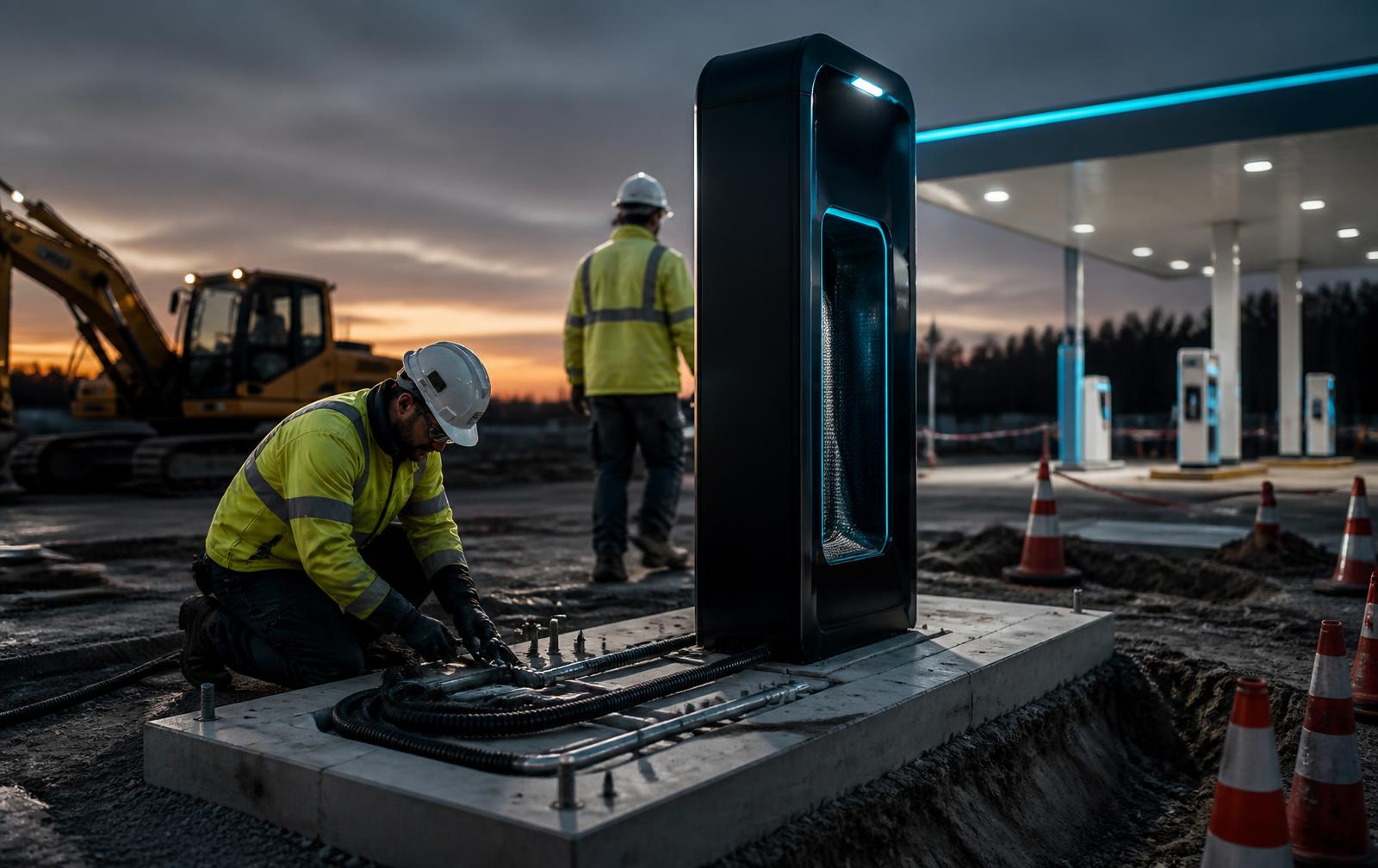
Installation and commissioning.
A site runs one electrical feed to a plinth. Everything else, including the compressors and the compute, arrives inside the unit. Typical programme is one survey visit, one groundworks day and one commissioning day.
Simulated real-world data being used for demonstration purposes
Site works allowance
£0
Plinth, feed termination and commissioning
Commissioning time
0 h
Anchoring to first live session
Electrical feed required
0
230V 32A radial, nothing else
Forecourt downtime
0
Works confined to the unit pitch
Site requirements
What the pitch needs to provide.
Assessed at survey and confirmed in writing before manufacture is scheduled. Anything outside these limits is quoted as an exception.
Programme
Survey to first session in six weeks.
Dates run from a confirmed order. Groundworks and commissioning are separate visits so the concrete reaches strength before the unit is anchored.
Week 0 - Site survey
Half dayPitch measured, substrate checked, board capacity and cable route assessed, hose reach proven against real vehicle positions. Survey report and fixed install price issued.
Week 1 - Design freeze and consents
Desk basedPlinth drawing, electrical schematic and signage layout signed off. DSEAR position confirmed and the site assessment updated.
Week 2 - Groundworks
1 dayPitch broken out where needed, plinth cast with the anchor template and cable duct set in place. Barriers left in situ while concrete cures.
Week 3 - Electrical first fix
1 daySWA pulled from the board to the plinth, isolator fitted, RCBO and surge protection installed, circuit tested and certified.
Week 5 - Delivery
2 hoursUnit delivered crated on a tail-lift vehicle, tilt and shock indicators inspected on arrival, crate returned for reuse.
Week 5 - Mechanical install
2 hoursUnit lifted onto the plinth, resin anchors set and torqued, levelled to 0.5 degrees, base sealed and cable glanded.
Week 5 - Commissioning
3 hoursPower on, earth continuity and insulation verified, compressors run in, four-channel calibration proven against a reference gauge, leak-down test recorded.
Week 5 - Mesh onboarding
30 minNode identity registered, connectivity proven on both SIM profiles, site published to the network map and the AiR app.
Week 5 - Training and handover
1 hourTwo staff trained on daily checks, free-vend mode and fault reporting. Handover pack issued with certificates, calibration record and warranty start date.
Week 6 - Post-install review
RemoteRemote review of the first week of sessions, pressure accuracy audit and a tuning pass on queue and hose behaviour.
Scope
Who does what.
The split is fixed and written into the order. It exists so nothing lands on the site team unexpectedly on the day.
AiR provides
Survey, plinth drawing, groundworks, mechanical install, commissioning, calibration, mesh onboarding, training, signage and the handover pack.
Site provides
The pitch, board capacity, the 230V 32A radial to the plinth, safe access during works and a named site contact.
On the day
One pitch cordoned off, no fuel or charging bay closures, no forecourt shutdown. Works are complete inside a single shift.
Handover pack
Electrical certificate, earth and insulation results, calibration record, leak-down report, written scheme for the receiver, O and M manual and warranty schedule.
Install costs
Where the site works allowance goes.
Indicative fixed-price breakdown for a standard forecourt pitch on an existing slab. Confirmed after survey.
Simulated real-world data being used for demonstration purposes. Figures are engineering estimates, not quotations.
Installation questions
What sites ask before signing.
Evidence base
Why a forecourt operator should care
The commercial case sits on documented demand: a very large share of vehicles arriving on any forecourt are already outside specification.
Drivers want help, not equipment
37% of drivers report low confidence inflating their own tyres, which is why a guided four-hose session converts where a coin-operated hose does not.2024
Cited on this page
- The Motor Ombudsman (2024). Driving under pressure is costing the nation's motorists at least GBP 112 million every year in lost tyres. The Motor Ombudsman research study.
- British Tyre Manufacturers' Association (2025). Where are tyres made? UK tyre supply volumes. BTMA.
- Tyres Europe (formerly ETRMA) (2026). Quarterly Statistics Update, Q4 2025. Tyres Europe.
- UK Department for Transport (2025). Reported road casualties in Great Britain (annual statistics). DfT official statistics.
These are published third-party sources, not AiR simulation. The full bibliography - peer-reviewed papers, reference monographs, government reports, international standards and official statistics - lives in the science lab.
Open the research and full bibliography