Machine simulator
The forecourt experience, end to end
A working simulation of the AiR unit: identify the vehicle, describe the load, review the manufacturer-approved targets, connect four hoses, and watch each channel measure, correct and stabilise independently.
Simulated real-world data being used for demonstration purposes
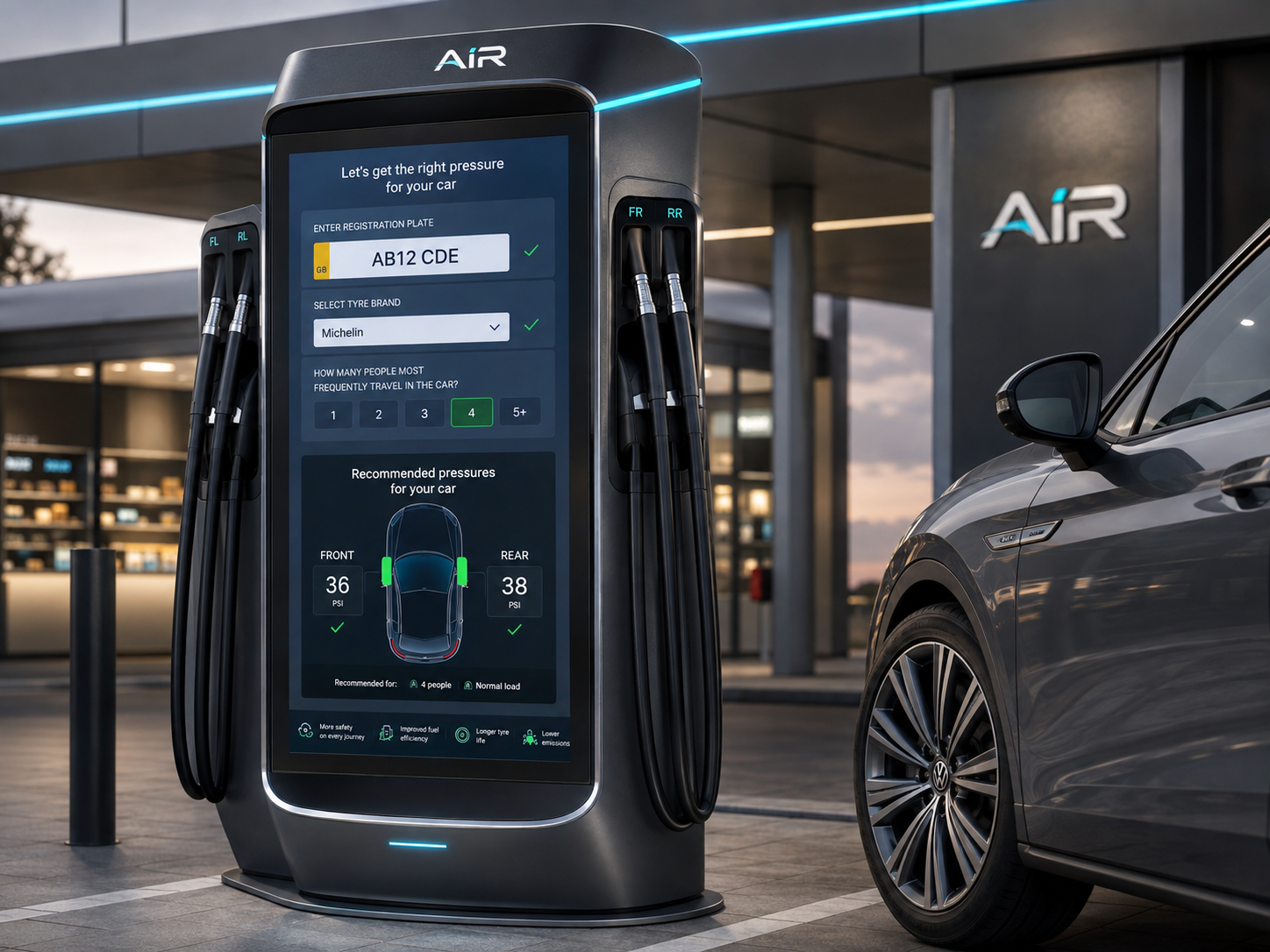

AiR intelligence active
Ready for every journey.
Live pressure. Perfect balance. Complete confidence.
Front left
32.0
PSI · 25°C
Front right
32.0
PSI · 25°C
Rear left
34.0
PSI · 26°C
Rear right
34.0
PSI · 26°C
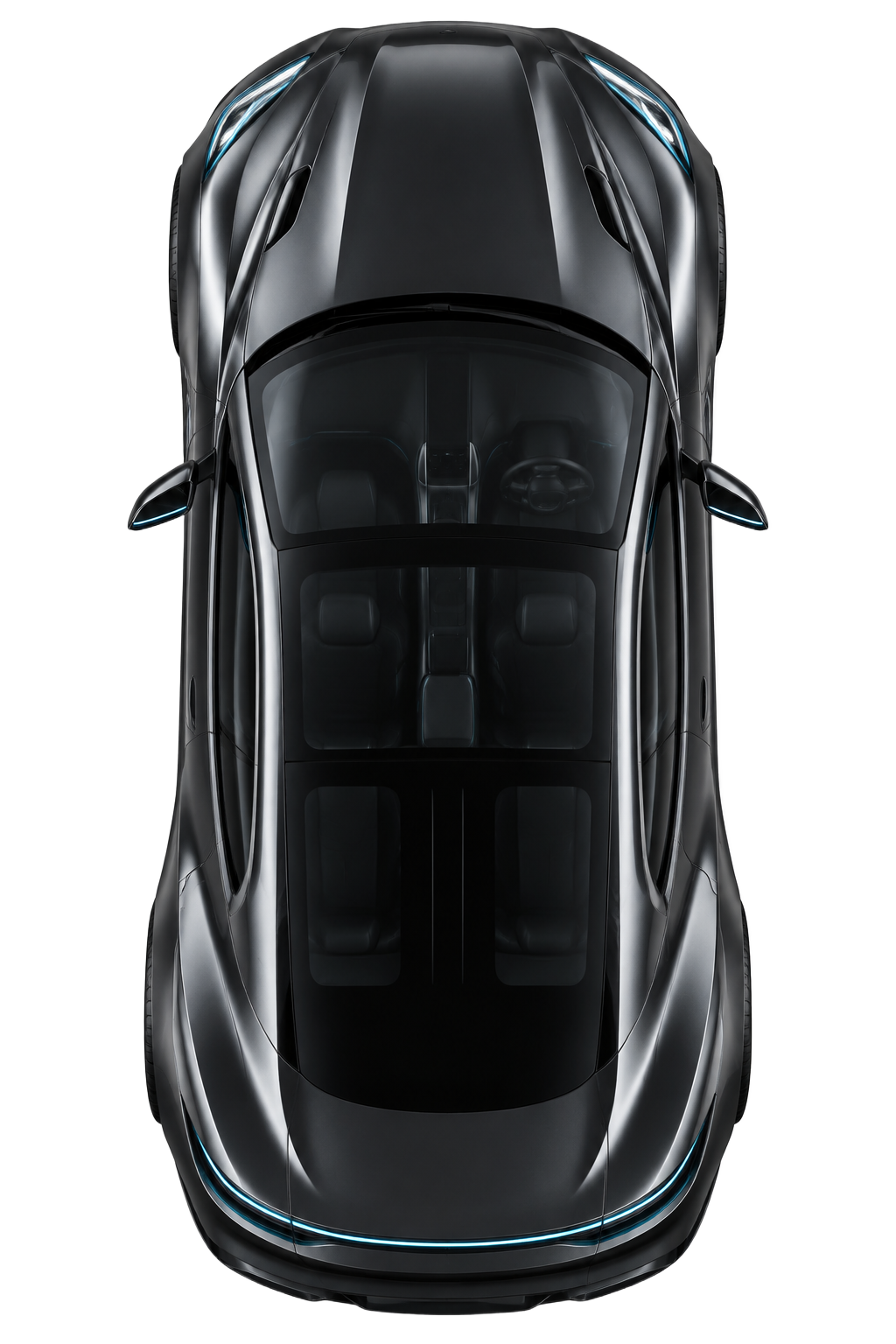
Guided check · under three minutes · AiR Mere
AiR Mere · TP-4 unit · simulated
Inject a condition, then run a session to see how AiR communicates it. Faults are simulated only.
No sessions yet. Completed checks appear here and in the AiR app.
Premium: AiR | Nitro and screenwash
AiR | Nitro: nitrogen made on site, from air
There are no cylinders and no deliveries. A busy forecourt doing 30 nitrogen fills a day would otherwise need about three cylinder swaps a day. Generating nitrogen needs only power and filters, runs at a safe 10 bar and can never run out. Available on MAX and HOME. Screenwash refill is MAX only.
AiR | Nitro purge and fill
The MAX makes its own nitrogen from air with a membrane separator. Each tyre is vented and refilled 3 times to lift purity from 78% to about 94%. The air let out of the tyres goes into a filtered recovery tank. It is reused as pump intake and keeps the sealed electronics bay slightly pressurised with clean, dry air.
Ready
N2 per car
~840 L
Tank holds
1000 L free
Recharge
~17 min
Screenwash pack
66 fills
All figures are AiR engineering estimates, pending supplier quotes and prototype testing. Every tank has a software-controlled electronic dump valve and a mechanical relief valve that works without power. The oxygen-rich waste from the membrane is always vented outside.
Evidence base
Why the machine behaves the way it does
Every rule in the session flow traces back to a published relationship or an approved table. The machine is a delivery mechanism for existing engineering knowledge, not a new theory of tyres.
Four channels because a tyre is an individual
Load distribution across an axle and around a vehicle is not symmetric once occupants, luggage and towing are added, and approved tables give front and rear values separately. Measuring and correcting one tyre at a time cannot deliver an axle specification.2025,1981
Closed-loop correction, not a timed fill
Load capacity is a function of achieved pressure, so the machine verifies each channel after settle rather than trusting a fill duration.2006
Cited on this page
- Gent, A. N. and Walter, J. D. (eds.) (2006). The Pneumatic Tire. US National Highway Traffic Safety Administration, DOT HS 810 561.
- European Tyre and Rim Technical Organisation (2025). ETRTO Standards Manual - load capacity and inflation pressure tables. ETRTO, Brussels, annual edition.
- United Nations Economic Commission for Europe (2016). UN Regulation No. 64 - Temporary-use spare units, run-flat tyres and tyre pressure monitoring systems. UNECE World Forum for Harmonization of Vehicle Regulations.
- US National Highway Traffic Safety Administration (2009). Tire Pressure Maintenance - A Statistical Investigation (DOT HS 811 086). NHTSA.
These are published third-party sources, not AiR simulation. The full bibliography - peer-reviewed papers, reference monographs, government reports, international standards and official statistics - lives in the science lab.
Open the research and full bibliography
Engineering knowledge, delivered
Every rule traces back to a published relationship or approved table.
Simulator notes
Everything the forecourt unit does, including the failures
The simulator is not a slideshow. It runs the same engine as the rest of the platform, so faults, temperature allowances and load profiles all behave the way they would on a real bay.
Injectable faults
0
Hose disconnect, valve fault, sensor drift, reserve loss and more.
Vehicle classes
0
Car, EV, van and motorcycle.
Channels simulated
0
Deterministic replays
0%
Run a solo commuter session first, then repeat the same vehicle fully laden with a roof box and watch the rear target move and the reasoning change.
- Switch to the motorcycle to see ride-ready mode and two channels
- Inject a hose disconnect mid-cycle and watch the other channels hold
- Set warm tyres and a high ambient to see the temperature allowance applied
- Force a non-stabilising channel to see slow-puncture reporting
Questions