
AiR TP-4 unit specification.
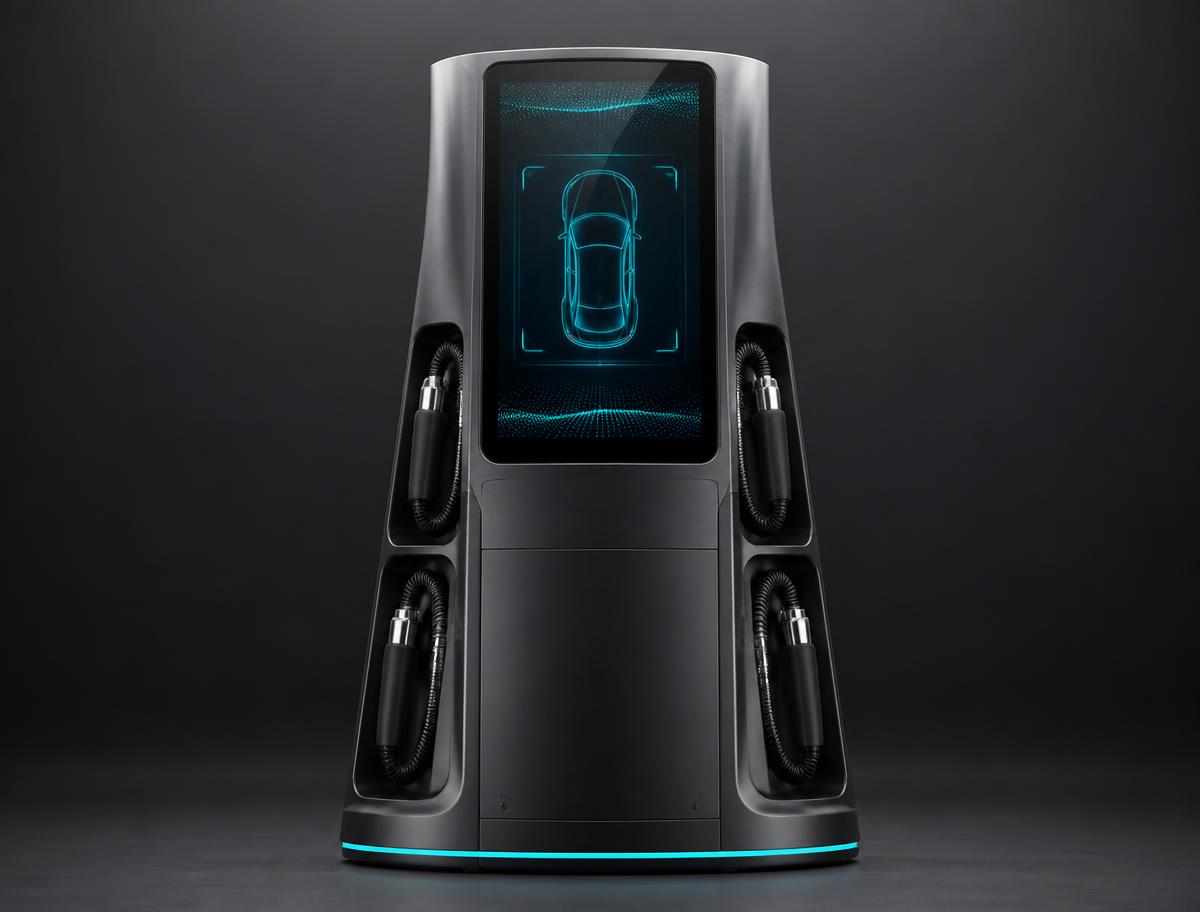
One sealed graphite enclosure, four independent air channels, on-board inference and a single 230V feed. This is the full engineering specification of the production unit, subsystem by subsystem.
Simulated real-world data being used for demonstration purposes
Channels per unit
0
Each tyre corrected on its own path
Delivered accuracy
+/-0.00 bar
Verified at end-of-line calibration
Four-tyre correction time
0 s
Typical car, 0.4 bar mean deficit
Noise at one metre
0 dB(A)
Oil-free scroll compressors, lined pod
Specification
The complete data sheet.
Grouped by subsystem. Figures are production-intent values for the TP-4 unit and are verified per machine at end-of-line test.
Inside the unit
Four partitions, serviced independently.
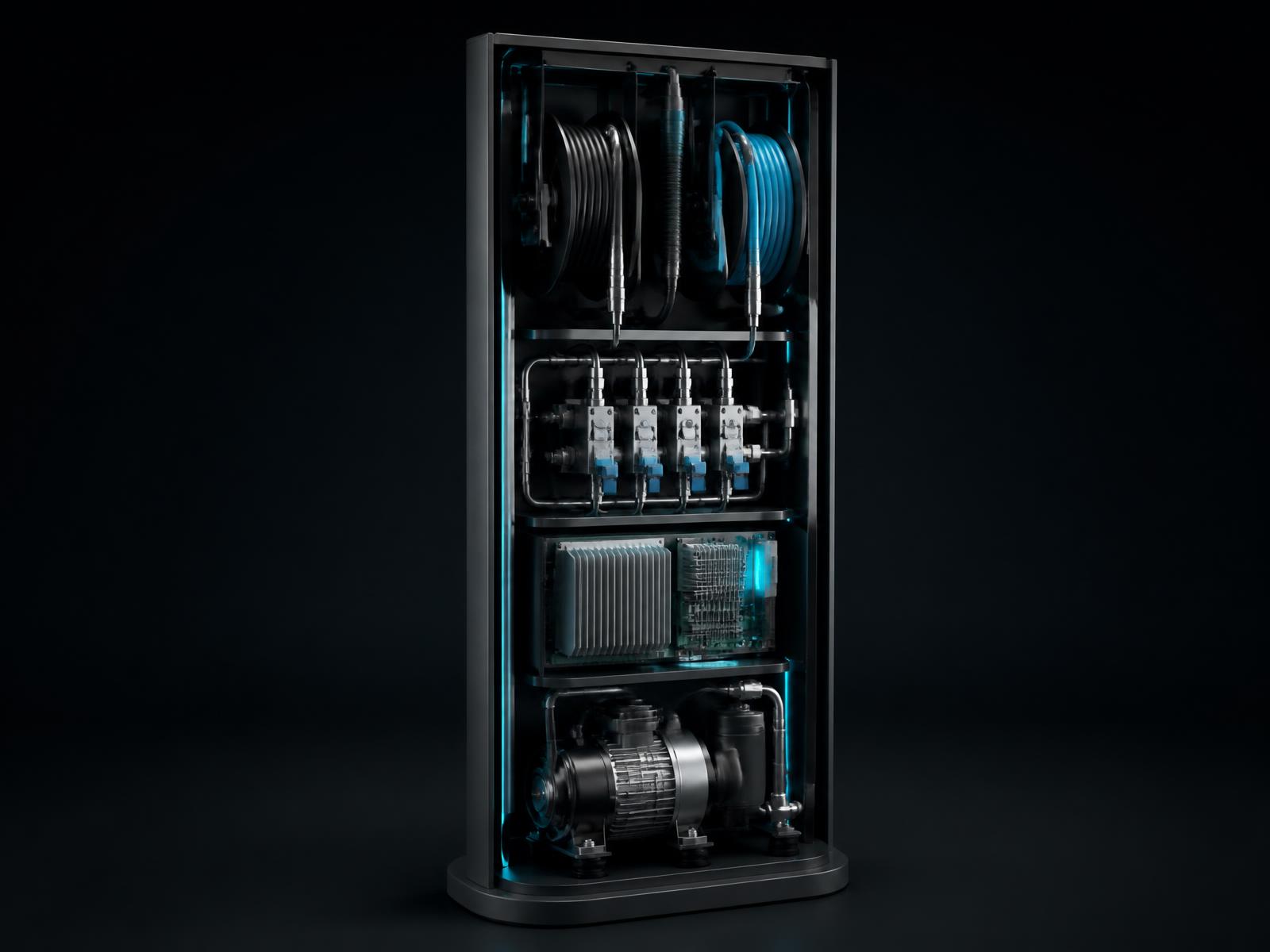
Acoustics at the bottom, air in the middle, compute behind the display, hoses at the sides. A service visit touches one partition without disturbing the others.
Silent by design
Oil-free scroll compressors on isolators inside a lined, ducted pod. No hammering piston noise and no forecourt ring main.
48 dB(A) at 1m
Clean, dry air
Refrigerant dryer and three filtration stages deliver class 2 air, protecting valves and the tyre alike.
ISO 8573-1 class 2
Independent channels
Four inflate and deflate pairs on a brass manifold with per-channel isolation, so one seized valve never stops a session.
4 x closed loop
Local intelligence
Recommendation and anomaly models run on the unit. Connectivity improves the fleet view but is never required to serve a driver.
Offline capable
Variants
One platform, three configurations.
All variants share the same pneumatic core, control stack and mesh identity. They differ in siting, payment and canopy options.
Standard unit
TP-4 Forecourt
The reference machine for fuel and charging forecourts. Contactless payment, free-vend option, four channels, plinth mounted.
Depot configuration
TP-4 Fleet Depot
Free-vend by default with driver or vehicle identification, higher duty compressors and a hardened depot hose set for daily commercial use.
Compact two-channel
TP-2 Urban
Two-channel unit for car parks, motorcycle bays and kerbside sites where space is tight. Same accuracy and the same mesh role.
Specification questions
What buyers ask first.
Pricing and commercial models
Unit price, subscription, revenue share and total cost of ownership over five years.
OpenInstallation and commissioning
Site survey, plinth, electrical works and the one-day commissioning sequence.
OpenWarranty and support
Three-year cover as standard, response times, spares holding and extended plans.
OpenSovereign comms and edge compute
IoT eSIM, LoRa and Reticulum mesh hardware, on-unit inference and the 170-node national grid.
OpenEvidence base
Standards the hardware and control logic answer to
The pneumatics and control stack are designed against existing type-approval and measurement frameworks rather than an internal standard.
Approved pressure tables are the authority
Target selection is bounded by ETRTO load-capacity tables and the vehicle placard. The controller cannot request a value outside them.2025
TPMS interaction is defined
UN Regulation 64 sets the European TPMS framework, including the warning threshold the machine deliberately works inside.2016
Labelling regime alignment
EU 2020/740 governs the label a consumer sees. Delivering the labelled performance requires delivering the labelled pressure.2020
Cited on this page
- European Tyre and Rim Technical Organisation (2025). ETRTO Standards Manual - load capacity and inflation pressure tables. ETRTO, Brussels, annual edition.
- United Nations Economic Commission for Europe (2016). UN Regulation No. 64 - Temporary-use spare units, run-flat tyres and tyre pressure monitoring systems. UNECE World Forum for Harmonization of Vehicle Regulations.
- United Nations Economic Commission for Europe (2016). UN Regulation No. 117 - Tyre rolling sound emissions, wet grip and rolling resistance. UNECE.
- International Organization for Standardization (2018). ISO 28580: Passenger car, truck and bus tyre rolling resistance measurement method. ISO.
- European Union (2020). Regulation (EU) 2020/740 on the labelling of tyres with respect to fuel efficiency and other parameters. Official Journal of the European Union.
These are published third-party sources, not AiR simulation. The full bibliography - peer-reviewed papers, reference monographs, government reports, international standards and official statistics - lives in the science lab.
Open the research and full bibliography