
AiR HP-1 G - AiR x Green Flag
Ready for every journey.

Cover that pays for itself in tread.
Green Flag sells on value, and correct inflation is the clearest value story in tyre care: less premature wear, lower fuel and energy use, fewer avoidable call-outs. A green AiR pump and a guided lap turn that argument into something the member does four times a year and can see in their own log.
Bundled with annual cover, and the efficiency case is the pitch.
Corners guided
0 + spare
Guided lap, none skippable
Display resolution
0.0 PSI
Settle reading after flow stops
Rolling resistance penalty
0.0 pct
Per 4 PSI under target, typical
Check cadence
0 days
Verified Care requirement
Concept co-branding created for partnership evaluation only, and not an endorsed Green Flag product. Commercial figures are simulated real-world data being used for demonstration purposes.
Benefits and features
What the member actually gets
One piece of hardware, one section inside the app they already have, and a habit that takes about two minutes.
01
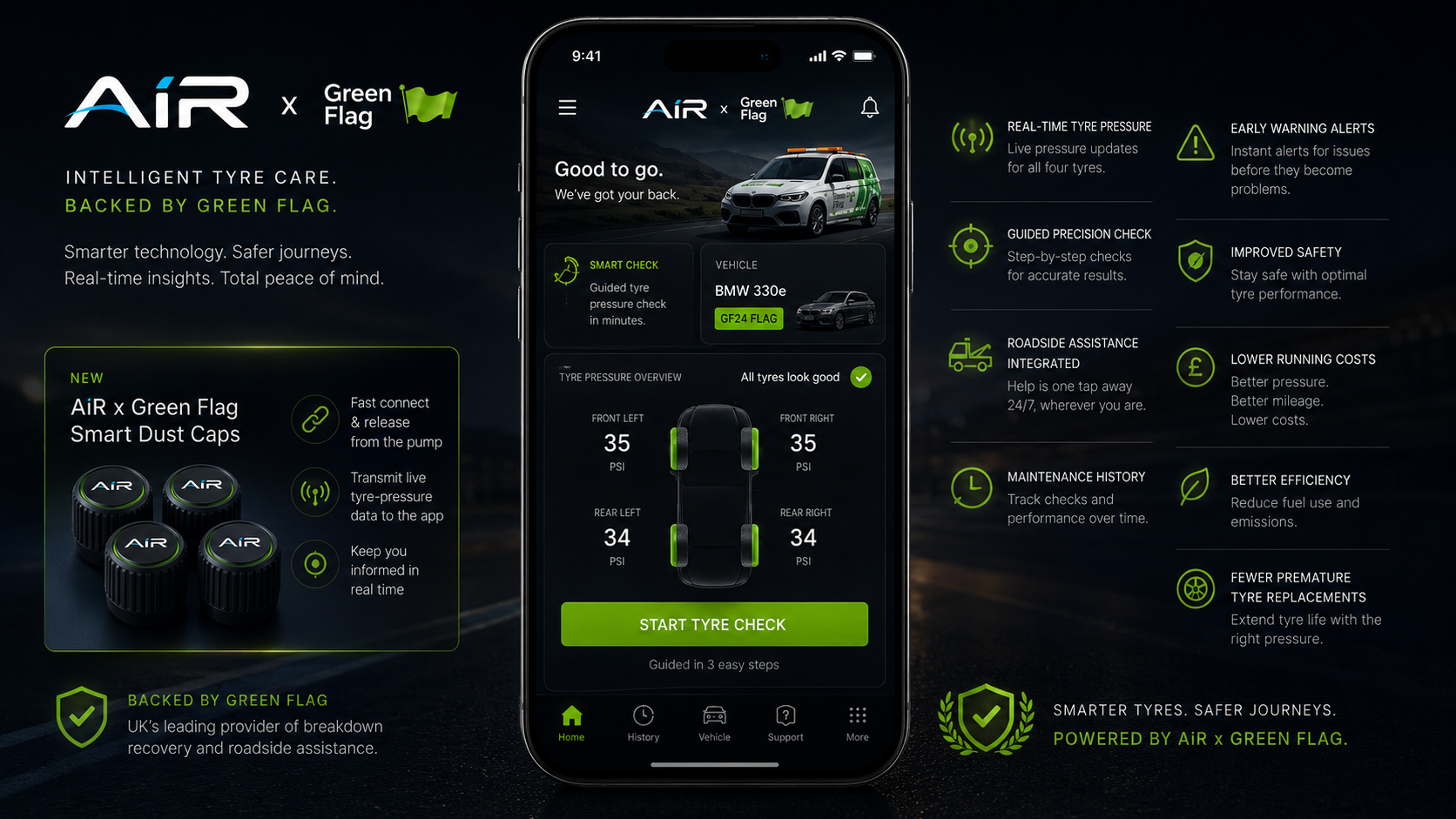
App-guided, corner by corner
The app runs the lap of the car and will not let a corner be skipped. No mental arithmetic, no remembering which wheel was done.
02
Targets built for the journey
Occupancy, luggage, roof load, towing and sustained speed all move the target. The placard leads and the engine only moves within the published light-to-full band.
03
0.1 PSI resolution
A calibrated transducer with a settle reading taken after flow stops, rather than a bouncing needle read while air is still moving.
04
Cold-pressure correction
Ambient temperature is measured and applied, so a check on a frosty driveway is not 3 PSI adrift of the same check in July.
05
Works anywhere
Driveway, car park, layby, hotel, abroad. No forecourt queue, no coins, no broken airline, no cable to the mains.
06
Every check logged
Full history per vehicle and per member, with trend detection on individual corners and a due date for the next check.
07
Warranty cadence built in
The 90 day Verified Care cadence is tracked for the member automatically and evidenced when a tyre claim is made.
08
Roadside handover
If a patrol does attend, the member's history is on the job card, so the technician starts with the pressure record rather than a guess.
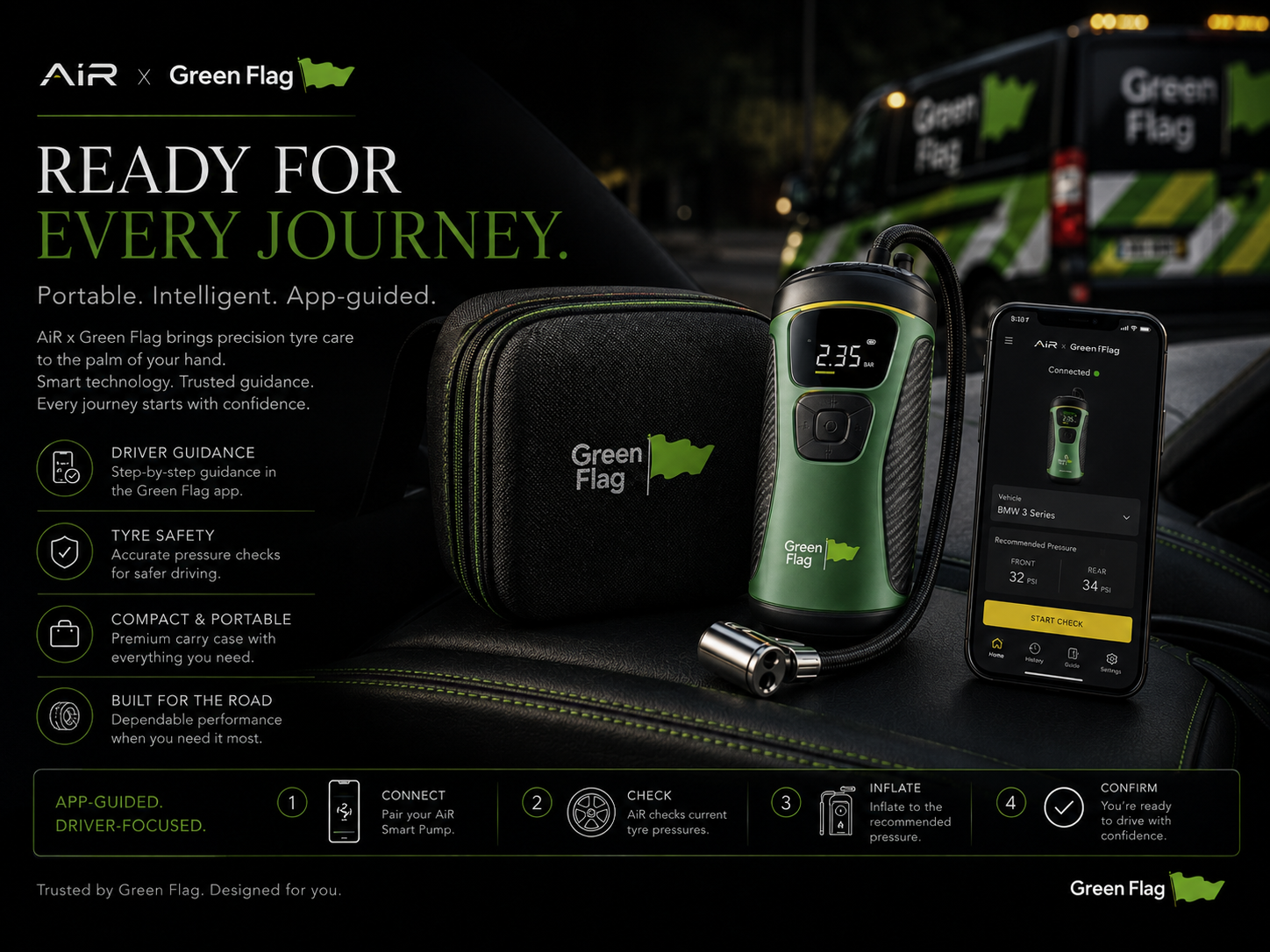
The handheld
AiR HP-1 G - the pump that travels with the member
The same derivation engine and the same guided lap as the forecourt station, in a case that lives in the boot. Portable, intelligent, app-guided.
01
Connect
Pair the pump to the member app, vehicle pulled from the membership record.
02
Check
Live reading and derived target side by side at every corner.
03
Inflate
Correction to target, then a settle reading at 0.1 PSI resolution.
04
Confirm
Corner turns green, the value is stamped into the vehicle's log.
Business case
Why this pays for Green Flag
Three returns from one piece of hardware: cost avoided on the road, authority earned in public, and members who stay because the benefit is used.
Kit cost per member
GBP 0
Landed at 250k units, case included
Member saving shown per year
GBP 0
Tread life plus fuel or energy, modelled per car
Modelled first-year return
0.0x
Weighted to retention rather than avoided jobs
Retention uplift modelled
0.0 pts
Value-led members respond most to a visible saving
A value brand with a value proof
Green Flag competes on price, and price competition is won by demonstrating cost avoided elsewhere. A modelled 108 GBP per car per year in recovered tread life and reduced rolling resistance is several times the 34 GBP kit cost, so the benefit funds itself and defends the premium against comparison sites.
From cheapest cover to smartest cover
Precision hardware repositions the brand from the discount option to the technically credible one. The EV story sharpens it further: heavier cars, higher placard pressures and range sensitivity make correct inflation an efficiency product, which is exactly where Green Flag wants to be seen.
The renewal conversation writes itself
The app carries a running saving figure per vehicle built from the member's own corrections. At renewal the number is theirs, not a marketing claim, and cancelling means giving up a benefit they can quantify.
Return figures are simulated real-world data being used for demonstration purposes.
Guided walk-around
One lap of the car, corner by corner
The app leads, holds each corner until it reads correct, then advances. Nothing is skippable and nothing is left to memory.
Set the journey, not the car
Step 00Before a single hose is touched, the app asks who is travelling and what is on board: solo, two up, family plus luggage, roof box, towing, motorway or town. The target set is built for that journey rather than the worst case printed on the door frame.
Front left - connect
Step 01The app opens at the driver's front corner and holds there. Push the chuck on, and the live reading appears within two seconds with the target beside it. Nothing else on screen can be tapped until this corner reads.
Front left - check, inflate, confirm
Step 02The pump corrects to target and settles, then reads back the final figure. The corner turns green, the value is written to the log with a timestamp and ambient temperature, and only then does the app advance.
Front right
Step 03The same four beats on the passenger front corner. Cross-axle difference is checked as the second reading lands: more than 2 PSI between a pair is flagged as a possible slow leak or a valve issue, not silently equalised.
Rear right
Step 04The lap continues around the back of the car in the direction you are already walking. Rear targets carry the load and luggage bias declared at step zero, which is where most family cars are furthest from correct.
Rear left
Step 05The final corner closes the lap at the driver's door. Spare or space saver is offered as an optional sixth check where the vehicle record shows one is carried.
Journey ready
Step 06One card: four corners, four confirmed values, deviation from target before correction, tread and age notes where held, and the next due date. Stamped to the vehicle history and to the member's Verified Care record.
Use case, not a generic number
A car driven by one person is not a car with five in it
Most drivers set one number for every journey, and most placards publish two or three columns for good reason. Pick a journey and watch the derived targets move.
Two up, light bags
front axle
31.5
PSI - 2.17 bar
547 kg per tyre, 81.7 percent of rated capacity
rear axle
22.0
PSI - 1.52 bar
350 kg per tyre, 52.3 percent of rated capacity
The everyday case. Front axle picks up both occupants, rear stays close to the light column.
Method - confidence high
- - Static axle loads from a 1620 kg kerb weight at a 58/42 split, plus 2 occupant(s) at 75 kg and 25 kg cargo biased 80 percent to the rear.
- - Per-tyre load scaled against the load index capacity at the 36 PSI reference, using load proportional to pressure to the power 0.8, with a 10 percent reserve.
Reference vehicle - mid-size family estate: 1620 kg on 225/45 R17 94W. Published placard window: 32 PSI front / 30 PSI rear light, 36 PSI front / 41 PSI rear full. The placard is always authoritative and the engine only moves the target inside the published band.
Tyre health log
Every check becomes a record, and the record becomes safety
A single reading tells you today. A history tells you what is failing, when to intervene, and what is happening across the whole road network.
A slow leak becomes visible
One reading is a snapshot. Twelve readings over a year are a gradient. A corner losing 1.5 PSI a month against three corners losing 0.4 shows up as a rim seal or valve fault long before it becomes a call-out on a hard shoulder.
Prompts arrive before the journey
The log knows the last check date, the season and the ambient trend. A cold snap or a long weekend triggers a nudge before departure rather than a warning light halfway there.
Warranty and Verified Care evidence
Tyre manufacturers and retailers can only honour a wear claim when correct inflation can be shown. A stamped 90 day cadence turns a disputed claim into a documented one, which is the whole basis of the Verified Care standard.
Fewer avoidable call-outs
Deflation, blowout and mis-seated valve incidents sit near the top of every roadside recovery reason code. Prevention that the member performs themselves is the cheapest intervention in the whole operation.
A national picture, anonymously
Aggregated and stripped of identity, the log answers questions nobody can currently answer: what proportion of cars on the road are more than 4 PSI down, how that varies by region, season and vehicle mass, and how it tracks against incident data.
Recorded per check

Motorsport precision
Hundredths of a bar, brought to the driveway
In professional motorsport, tyre pressure is a primary element of the car's safety and performance envelope, set to 0.01 bar. On the road it is a number half-remembered from a door frame.
Pit lane works in hundredths of a bar
0.01 barA race engineer sets cold pressures to 0.01 bar, roughly 0.15 PSI, because that resolution changes contact patch shape, tyre temperature and the point at which the car loses grip. Nothing about that physics is exclusive to a racing car.
The road user works in whole guesses
about 30A forecourt airline reads to the nearest whole PSI on a good day, is frequently out of calibration, and is used against a single number remembered from a door frame. The gap between the two worlds is not knowledge, it is instrumentation.
Pressure is a primary safety system
Braking, steering, aquaplaningPressure sets the contact patch. The contact patch sets braking distance, steering response, aquaplaning onset and the load a sidewall carries over a pothole. It belongs in the same conversation as brakes and seatbelts, not with screen wash.
Load-aware targets, the motorsport habit
Per sessionNo team sets one pressure for every session. They set for fuel load, track temperature and stint length. This programme brings the same habit to a road car: set for the journey in front of you, then prove it was set.
Measured, logged, repeatable
Every checkThe discipline that matters is not the equipment, it is the record. Every check is timestamped and kept, so drift is measurable and behaviour is provable - the same reason a garage keeps a set-up sheet.
Detail
Specification, commercials and questions
The programme