
Sovereign road-edge compute
Every installed AiR unit is a tyre-safety appliance and a secure edge-compute node
Safety first, compute second. This page models how onboard inference, federated fine-tuning and scheduled tenant workloads share a bounded slice of each node, and what happens to that split as connectivity and power degrade.
Allocation, energy and round-time figures are produced by a deterministic planning model. Module TOPS and power envelopes are published vendor specifications, cited in the sources at the foot of this page.
Workload simulator
Edge AI workload and federated learning simulator
Choose a hardware tier, a connectivity state, a power state and a cohort size. The scheduler model reserves the tyre-safety control loop first, then allocates whatever the host has consented to share.
Controls
Hardware tier
Jetson Orin NX - Standard forecourt, 10 - 40 W.
Connectivity state
Power and thermal state
Available per node
157TOPS
157 TOPS peak, derated by power state
Node utilisation
89.9%
15.8 TOPS idle headroom
Safety reservation
43.9TOPS
Control loop plus local intelligence
Shared compute
97.3TOPS
62% of the node
Scheduler allocation - Full cloud-connected, Mains, nominal thermals
Site ethernet or Wi-Fi plus IoT eSIM. Bulk model distribution and tenant inference payloads flow normally.
Guaranteed reservation. Runs identically in every connectivity and power state.
Local only. No dependency on upstream connectivity.
Local passes over local data. Only signed deltas leave the node.
Sandboxed tenant work units, quota-bounded and isolated from the tyre-safety control plane.
Federated learning round
Raw driver and vehicle data never leaves the node. Only signed model deltas and secure aggregates move, and they only ever move over IP. Gradient traffic is never placed on the LoRa plane.
Cohort aggregate - 1,000 nodes
Compared on published peak INT8 throughput only. It does not imply equivalent training capability, memory capacity, model size, network performance or workload latency.
Scheduler notes for this state
- A host share above 60 percent should be contracted with an explicit thermal, power and privacy schedule.

Safety first, compute second
Shared workloads are pre-empted automatically before any tyre-safety function is affected. That ordering is a hardware and scheduler guarantee, not a policy preference.
Strategic thesis
Four simultaneous roles in one installed asset
AiR already has a justified reason to exist at the point where journeys begin and end. That gives it a maintained, powered physical footprint distributed through forecourts, dealerships, homes, depots and mobility hubs.
Tyre-safety appliance
Local sensing, four-channel pressure control, ACT workflows, pre-journey checks and vehicle interaction.
Edge AI computer
Local inference, anomaly detection, vision where fitted, privacy-preserving feature extraction and model execution.
Communications node
Ethernet, Wi-Fi and cellular IoT for normal transport; LoRa and Reticulum for resilient low-bandwidth communications.
Distributed infrastructure node
Securely schedulable spare compute, local storage, signed telemetry and participation in a national sovereign edge fabric.
Exact architecture
Seven layers, from the valve to the sovereign control plane
Each layer has a fixed role, a fixed component set and a fixed data residency. Nothing above L1 can delay, block or degrade the safety control plane.
L0 Physical node
NodeThe installed asset. Sensing, four-channel pneumatics, screen, secure element and radios in one sealed enclosure.
L1 Safety control plane
Node onlyThe deterministic tyre-safety engine. Runs to completion with no external dependency and pre-empts everything above it.
L2 Local inference runtime
NodeOnboard AI. Anomaly detection, leak-pattern recognition, sensor fusion and privacy redaction before anything leaves the device.
L3 Transport layer
Node and anchorDual plane. High-bandwidth IP for bulk traffic, Reticulum over LoRa as an independent out-of-band resilience path.
L4 Regional anchor layer
Region170 backbone anchors provide regional persistence, job brokering, encrypted caching and Reticulum transport.
L5 Sovereign control plane
UK sovereign serviceUK-hosted identity, scheduling, model distribution, attestation and revocation. Owns orchestration, never owns raw driver data.
L6 Application and tenancy plane
UK analytics and tenant planesDriver app, partner portals, research analytics and isolated compute tenancy, each with its own namespace and quota.
Dual-plane transport
A primary data plane and an independent sovereign resilience plane
The two planes share no dependency. When commercial connectivity fails, the resilience plane keeps safety and operational messaging alive at low bandwidth.
Primary data plane
Ethernet
Permanent forecourt, dealership, fleet depot and commercial sites
Preferred where available: highest bandwidth, lowest cost per byte
Wi-Fi 6/6E
Home units, dealer premises and managed local networks
Primary path for the residential estate
Industrial eSIM / eUICC
Every node as either primary or failover
Multi-network UK roaming, private APN or static addressing where commercially available
5G fixed wireless or satellite
Selected backbone anchors only
Diverse second backhaul at strategic sites
Sovereign resilience plane
What LoRa carries, and what it must never carry
| Message | Resilience plane | Transport |
|---|---|---|
| Node heartbeat and health | Carried | LoRa with a cellular duplicate |
| Alarm, tamper and outage alert | Carried | LoRa first when IP is unavailable |
| Signed location and site status | Carried | LoRa |
| Small command and job metadata | Carried | LoRa where the payload permits |
| Emergency text and service message | Carried | Reticulum |
| Model binaries | Never | Ethernet, Wi-Fi or cellular |
| Video and images | Never | Ethernet, Wi-Fi or cellular |
| Large telemetry batches | Never | Ethernet, Wi-Fi or cellular |
| Distributed inference tensors | Never | High-bandwidth IP only |
Data flow
From valve to analytics plane, in eight stages
Classification happens on the node and is immutable afterwards. A message's class fixes its transport, its priority and where it is allowed to be stored.
Sense
Node, L0Pressure, temperature, valve state and session context captured at the channel. Raw sensor data never leaves the enclosure in raw form.
Decide locally
Node, L1The deterministic engine selects an approved profile, applies the thermal allowance and safety clamp, and drives the channels. No network dependency exists at this stage.
Infer and redact
Node, L2Onboard inference runs anomaly, leak-pattern and integrity checks, then the redaction pipeline strips identifiers and derives features before anything is queued for transport.
Sign and classify
Node, L2The session record is signed with the device key and each outbound message is tagged P0 to P4, which fixes its transport, priority and residency for the rest of its life.
Transport by class
L3P0 and P1 take whichever path is available, LoRa included. P2 to P4 wait for IP. Bulk traffic is deferred to off-peak windows and never touches the resilience plane.
Broker regionally
Anchor, L4Anchors cache models, broker compute work units, forward Reticulum traffic and hold store-and-forward queues for nodes that are currently unreachable.
Reconcile centrally
Control plane, L5Signed sequence numbers and idempotent processing mean queued events replay safely when IP returns. Duplicate delivery over two planes is expected and harmless.
Aggregate and serve
L6Personal records land in the UK sovereign service, anonymised trends in the analytics plane, tenant outputs in an isolated namespace. The three are never joined.
When the primary path fails
Federated learning: raw data never moves
Hardware-bound identity lifecycle
- 01Every unit receives a hardware-bound AiR identity during manufacture.
- 02Private keys are generated or injected inside a hardware security module or TPM-class secure element.
- 03The device certificate is tied to serial number, board identity, site and lifecycle state.
- 04A second, separate Reticulum identity is issued for the resilient communications plane.
- 05Compromised or retired devices are revoked centrally and blackholed on the sovereign plane.
Zero-trust controls at every node
- Mutual authentication on every service-to-service connection
- Signed firmware and signed model packages
- Secure boot and measured boot
- Least-privilege containers for inference workloads
- Encrypted local storage
- Remote attestation where hardware supports it
- No acceptance of unsigned workloads
- Per-tenant scheduling and resource quotas
- Independent security logging and tamper events
Deployment assumptions
The 170-anchor backbone, stated as planning assumptions
These are assumptions and design targets, not measured coverage. They are published in this form so they can be tested rather than believed.
UK land area
0 km2
Backbone anchors
0
Average per anchor
0 km2
Planning-cell radius
0.0 km
Anchor site selection
- Motorway and trunk-road service areas
- Large dealer groups and mobility campuses
- Roadside-assistance operational sites
- Fuel retail estates and logistics hubs
- Selected rooftops, towers and elevated commercial properties
- Ports, airports and strategic freight corridors
- Resilience sites near critical junctions and in regions with poor conventional connectivity
Required before any coverage claim
- Propagation modelling against real terrain data
- Antenna-height optimisation per site
- Interference analysis in shared spectrum
- Regulatory compliance for UK LoRa spectrum use
- Drive testing to measure, not model, achieved coverage
The 21.4 km figure is an average planning-cell equivalent derived by dividing UK land area by 170, not a coverage claim. Urban clutter can reduce useful LoRa reach substantially and elevated line-of-sight paths can extend it well beyond it.
Anchors versus ordinary nodes
Anchors provide regional persistence and bridging. Ordinary forecourt and home nodes are Reticulum instances, and only a selected subset become local transport nodes where density and topology justify it. That is what turns 170 anchors into a practical national mesh rather than 170 isolated radios.
Why the cost case is a systems argument
IoT connectivity contract requirements
- Industrial eSIM / eUICC profiles supporting more than one UK mobile network
- Static or private addressing options
- VPN or private APN capability
- Roaming control and pooled data allowances
- Remote SIM lifecycle management
- Full API access for provisioning and diagnostics
- The SIM is transport, not sovereignty: sovereignty comes from AiR-controlled identity, keys, software, data routing and the independent fallback path
Hardware tiers
Three node classes, tens of watts each
Peak AI performance figures are the published NVIDIA Jetson specifications for each module. Annual energy assumes the full compute envelope held continuously, which no real duty cycle reaches.
| Tier | Deployment | Module | Peak INT8 | Power | Storage | Annual kWh at 100% |
|---|---|---|---|---|---|---|
| H1 | Home wall-mounted | Jetson Orin Nano Super | 67 TOPS | 7 - 25 W | 512 GB - 1 TB NVMe | 219 kWh |
| F1 | Standard forecourt | Jetson Orin NX | 157 TOPS | 10 - 40 W | 1 - 2 TB NVMe | 350 kWh |
| F2 | High-value site / backbone anchor | Jetson AGX Orin | 275 TOPS | 15 - 60 W | 2 TB NVMe + regional cache | 526 kWh |
Suited to the edge fabric
- Embarrassingly parallel inference batches
- Regional risk scoring
- Anonymised tyre-health feature extraction
- Model A/B evaluation
- Synthetic-data generation at idle nodes
- Federated fine-tuning where data stays local
- Map-reduce analytics across geographically partitioned datasets
Not suited, and not claimed
- Tightly coupled large-model training that depends on NVLink or InfiniBand fabrics
- Single jobs needing hundreds of gigabytes of unified accelerator memory
- Latency-locked synchronous all-reduce at national scale
- Anything requiring raw driver or vehicle data to leave the node
Large training runs depend on tightly coupled NVLink and InfiniBand fabrics. The honest position is a complementary national inference fabric, not a replacement for hyperscale.
What the national scheduler knows
- Hardware tier and available accelerator memory
- Live thermal headroom and fan health
- Local queue depth and safety-session duty cycle
- Connectivity class and measured uplink quality
- Site policy and host consent tier
- Power state, UPS status and tariff window
- Attestation state and firmware signature validity
Jobs are decomposed into small signed work units and dispatched only to eligible nodes. Unsigned workloads are never accepted, and tenant namespaces cannot reach vehicle or user data.
Dry-cooling thermal hierarchy
- 01Passive chassis conduction as the first thermal path
- 02Large external fin area integrated into the cabinet structure
- 03Low-speed filtered fans only when required
- 04Temperature-aware inference scheduling
- 05Automatic compute throttling before tyre-safety functions are affected
- 06No evaporative or chilled-water loop at the edge node
A central AI campus concentrates tens or hundreds of megawatts into one thermal zone. AiR distributes tens of watts across thousands of sites, so zero on-site cooling water at the node is a design target rather than a marketing line.
Equivalence, stated honestly
What a 100 MW comparison actually means
A 100 MW rating is an electrical capacity figure, not a compute figure. This model fills 100 MW with DGX H200 systems at their maximum system input and ignores facility overhead, storage and switching so the arithmetic stays checkable.
Reference systems
0
DGX H200 at 10.2 kW system input
Reference GPUs
0
Eight H200 SXM per system
Peak INT8 per GPU
0 TOPS
Reference peak
0M TOPS
Theoretical peak INT8 only
If the network were only 170 backbone sites, each anchor would need roughly 1.83 million TOPS, which is mini data-centre territory. The attractive model is the inverse: use the 170 anchors to coordinate a very large population of low-power nodes already justified by the core tyre-safety business.
Cohort against the reference
Move the cohort slider in the simulator to see where the installed estate crosses one percent, ten percent and parity on this narrow peak-throughput metric.
Dual-plane network
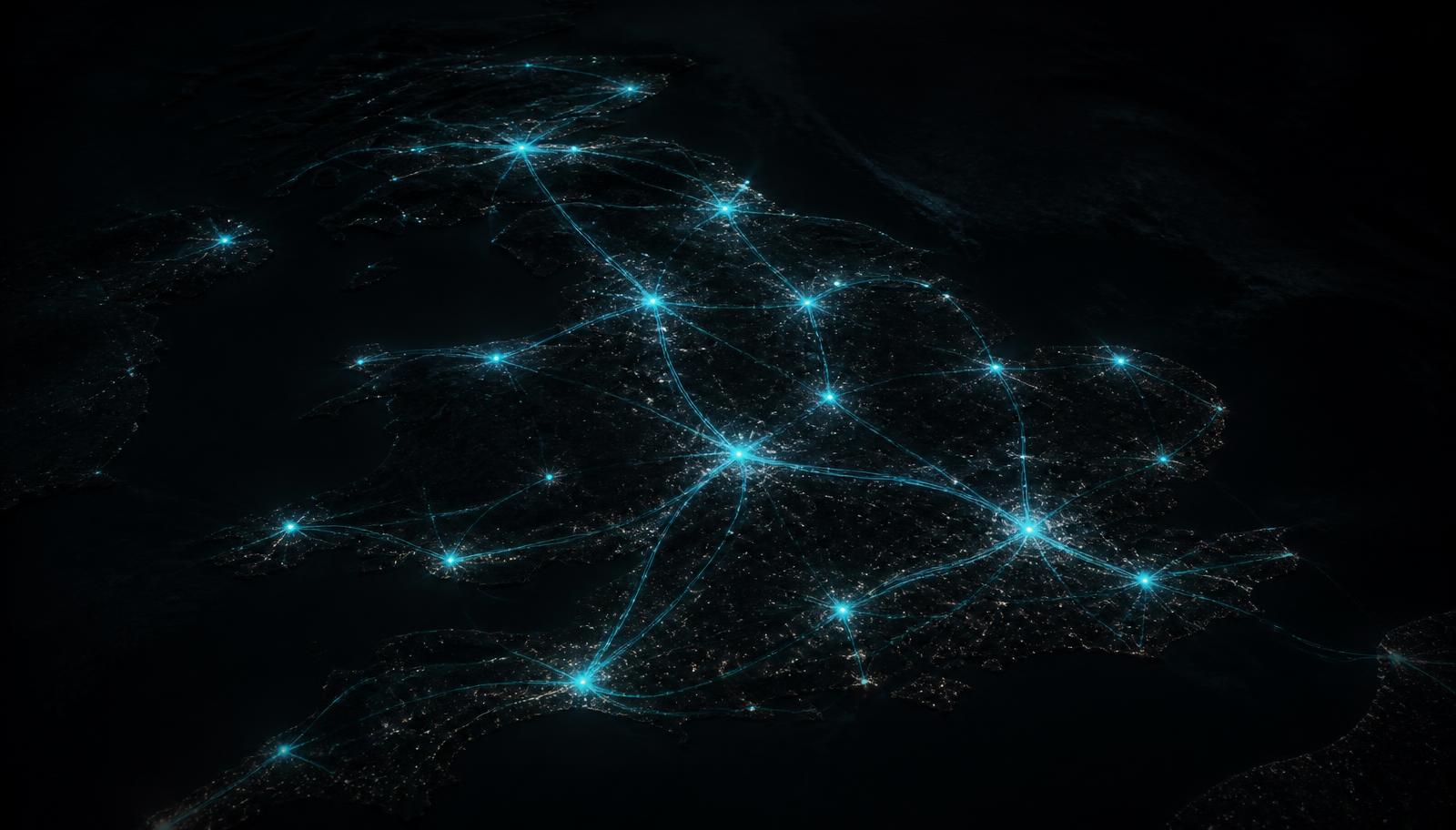
A high-bandwidth commercial data plane for normal operation, plus a cryptographically secured sovereign resilience plane that keeps exchanging essential messages independently of the public Internet.
Traffic classes and priority
Device alarms, safety fault, critical control
Telemetry, job status, software health
Compressed analytics and research uploads
Distributed inference payloads
Model downloads, logs, archives
Graceful degradation in five layers
Full cloud-connected
Mode 1Site IP plus cellular. All five traffic classes flow, tenant inference and model distribution included.
Cellular-only
Mode 2Private APN carries P0 to P2 normally; P3 and P4 move into policy-controlled off-peak windows.
Local-site
Mode 3No upstream IP. Local inference and site aggregation continue, bulk data queues on encrypted local storage.
Reticulum / LoRa fallback
Mode 4Essential P0 and P1 messages shift to the sovereign plane via nominated transport nodes and store-and-forward.
Isolated safe-local
Mode 5Every external link is gone and the core tyre-safety function still runs, signing records for later reconciliation.
Data sovereignty
Where each class of data is allowed to live
Sovereignty is not the SIM card. It comes from AiR-controlled device identity, cryptographic trust, software, key management and an independent fallback path.
| Class | Examples | Default location |
|---|---|---|
| Safety-critical local | Pressure control state, valve status | Node |
| Personal / vehicle linked | Registration-linked history, account data | UK sovereign service |
| Research aggregate | Anonymised pressure and usage trends | UK analytics plane |
| Compute tenant | Tenant model inputs and outputs | Tenant-isolated namespace |
| Security | Attestation, audit, tamper events | UK security plane |
Sovereign requirements
- UK-hosted control plane and identity infrastructure
- UK-controlled keys and certificate authorities
- Documented data residency and processor chain
- Offline-capable core safety function
- Software bill of materials and signed supply-chain artefacts
- Independent penetration testing and recurring security assurance
- Clear separation of public-interest data from commercial compute tenancy
The correct wording is cryptographically secured and zero-trust by design. No credible network promises absolute security.
Reference architecture
What actually goes inside each node class
Forecourt node
- Jetson Orin NX-class accelerator as baseline, AGX Orin at high-value sites
- 1 - 2 TB NVMe local storage
- TPM or secure element, dual ethernet where practical, Wi-Fi 6/6E
- Industrial eSIM with multi-network management
- RNode-compatible LoRa radio and external antenna, optional GNSS
- Thermal and fan-health sensing, UPS or supercapacitor for graceful shutdown
Home node
- Orin Nano-class accelerator
- Wi-Fi or ethernet primary, IoT eSIM as a premium option
- LoRa and Reticulum radio
- 512 GB - 1 TB local storage
- Passive-first wall-mounted thermal design
Backbone anchor
- AGX Orin or a small multi-accelerator edge server
- Dual diverse IP backhaul
- High-gain, professionally engineered LoRa antenna system
- Larger UPS and monitored power
- Regional Reticulum transport-node role
- Encrypted regional cache and job broker
Deployment phases
Phase 0 - Lab
10 - 25 nodesValidate hardware, Reticulum, LoRa, the scheduler and secure identity end to end.
Phase 1 - Regional pilot
100 - 250 nodesProve mixed cellular and LoRa operation plus real distributed inference against live sites.
Phase 2 - 170-anchor backbone
170 anchors + thousands of edge nodesEstablish the national resilience spine with elevated, redundantly backhauled transport nodes.
Phase 3 - Commercial density
10,000 - 100,000 nodesCreate a distributed compute fabric with enough aggregate throughput to sell capacity.
Phase 4 - National infrastructure
100,000s to millionsSovereign road-edge AI network at hyperscale-class aggregate peak throughput.
Gate criteria before any national claim
- Measured RF coverage, not theoretical coverage
- Measured task throughput and utilisation
- Measured power and thermal envelope
- Independent cyber-security assessment
- Failure-mode testing with cellular and Internet removed
- Demonstrated store-and-forward delivery across Reticulum transport nodes
- Documented UK spectrum compliance
Revenue layers on one installed asset
- Core AiR tyre-safety service
- Premium AiR Home hardware and subscriptions
- Fleet connectivity and management
- Connectivity margin and managed IoT service
- Sovereign edge-inference capacity
- Research and aggregated road-intelligence services
- Resilience-network service contracts
- OEM and dealer private edge namespaces
Engineering truths
Claims we will not make, and the position we hold instead
Each row is a misconception this architecture is routinely credited with, paired with the position AiR states publicly.
'170 LoRa sites cover the whole UK'
Treat 170 as backbone anchors. Coverage is proven with RF engineering and edge-node density, not map circles.
'LoRa can carry distributed AI traffic'
No. LoRa carries low-rate control, status and resilience traffic. Bulk compute traffic uses IP.
'100 MW equals a fixed amount of compute'
No. A reference architecture and numeric precision must be stated before any comparison.
'Edge compute replaces hyperscale'
Only for suitable distributed inference workloads, never tightly coupled training.
'Completely secure'
Zero-trust, hardware identity and encryption. No credible network promises absolute security.
'No water'
Zero on-site cooling water is claimable only where the production thermal design genuinely uses dry cooling.
'Cellular is sovereign'
Cellular is a transport dependency. Sovereignty comes from AiR-controlled cryptography, data, software and fallback paths.
Technical basis
Sources
- [1]Reticulum Network Stack - 'What is Reticulum?' and networking documentation. Cryptographic local and wide-area networking under low-bandwidth, high-latency conditions.
- [2]Reticulum Network Stack - RNode LoRa interface documentation. Reticulum operates over LoRa with direct control of LoRa parameters.
- [3]NVIDIA Jetson Orin Nano Super - up to 67 INT8 TOPS, published low-power operating envelope.
- [4]NVIDIA Jetson Orin NX - up to 157 TOPS, configurable low-power edge module.
- [5]NVIDIA Jetson AGX Orin - up to 275 TOPS at 15 - 60 W configurable power.
- [6]UK House of Commons Library - 'Data centres: planning policy, sustainability, and resilience', 27 May 2026.
- [7]Reticulum - 'Building Networks'. Every node can be a transport node, but enabling transport everywhere degrades performance.
- [8]Reticulum communications hardware documentation - RNodes use raw LoRa modulation with Reticulum providing higher-level protocol functions.
- [9]Reticulum - 'Understanding Reticulum' and API reference. X25519, Ed25519 and AES-based encryption with ephemeral keys.
- [10]Reticulum - 'Building Networks'. Trustless networking, interface access codes and encrypted transport behaviour.
- [11]NVIDIA DGX H100/H200 user documentation - eight GPUs per system, 10.2 kW maximum system input.
- [12]NVIDIA H200 specifications - up to 3,958 INT8 Tensor Core TOPS per H200 SXM GPU, up to 700 W TDP.
- [13]LoRa Alliance - LoRaWAN overview. Low-power wide-area networking for massive IoT and small, low-rate data flows.
Methodology note: the 100 MW equivalence assumes 100 MW of DGX H200 system input and deliberately ignores facility PUE, storage, network switching and redundancy so the arithmetic remains transparent. The result is a theoretical peak-throughput reference, not a data-centre design or a benchmark.