
The AiR story
From the grid to the school gate
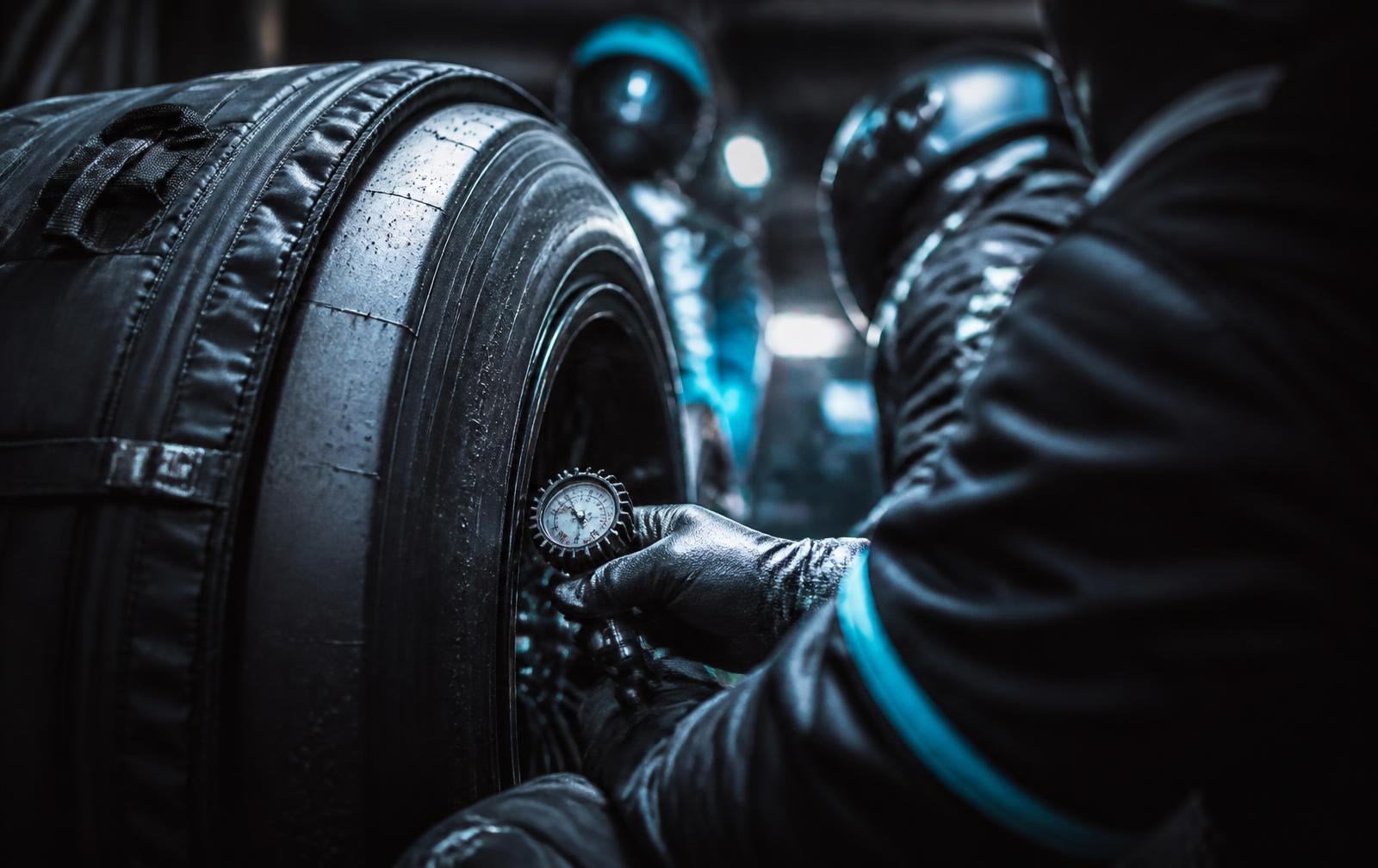
In professional motorsport, tyre pressure is a safety system. It is measured to a hundredth of a bar, set per corner, and re-checked before every single run. Nobody in the paddock calls that excessive. They call it the minimum.
Now picture the same physics at 8:20 on a wet Tuesday morning: a family car, two children in the back, bags in the boot, four tyres nobody has touched since spring. The stakes went up. The precision went away.
AiR exists to close that gap. Not with a lecture, and not with a gauge on a chain. With a machine that connects to all four wheels, corrects each one to the pressure that vehicle and that load actually require, and hands back a record - in about ninety seconds, on the forecourt people already visit.
Paddock tolerance
0.00 bar
Pressure set per corner before every run
Legal warning threshold
0% under
When the dashboard light is finally required
UK cars 10% or more under
0%
National under-inflation prevalence
AiR correction time
0 sec
All four wheels, one session
Warning threshold per UN Regulation 642016. Under-inflation prevalence per The Motor Ombudsman national study2024.
The precision gap
Same physics. Two entirely different standards.
A race tyre and a family tyre obey identical mechanics: an inflated structure carrying load through a contact patch about the size of a postcard. Only one of them is managed like it matters.
| Dimension | Pit lane | School run |
|---|---|---|
| Who sets the pressure | A tyre engineer, per corner, per stint, against track and ambient temperature | The driver, occasionally, from memory or a sticker in the door shut |
| Measurement standard | Calibrated to hundredths of a bar, logged every session | A forecourt gauge of unknown calibration, if it works at all |
| Load accounted for | Fuel load, aero balance, driver weight, stint length | Rarely. Four passengers, luggage and a roof box change the correct pressure |
| Frequency | Before every run, without exception | Months apart. Permeation quietly removes pressure the whole time |
| What triggers action | A deviation of a few hundredths | A dashboard light that legally only has to appear at 20 percent under |
| Consequence of error | Lap time, then a team debrief | Longer stopping distances, aquaplaning at lower speeds, tread gone early |

The uncomfortable comparison
A racing driver goes out on tyres checked minutes earlier, on a closed circuit, wearing a harness, with a medical car on standby. A parent pulls out onto a live road in the rain, carrying the people they care about most, on tyres last checked at some point they cannot remember.
We think the precision belongs where the consequences are highest. That is the school gate.
The school gate standard
What we believe should be normal
Five commitments, written plainly, that describe the standard AiR is built to deliver for ordinary drivers.
01
Correct is not approximate
Every wheel set to the pressure the vehicle and its actual load require, not a single number for the whole car.
02
No skill required
No gauge to read, no valve to fight, no kneeling on a wet forecourt. Connect four hoses and press start.
03
Load-aware by default
Two children, three bags and a roof box are a different vehicle. The correct pressures change with them.
04
Evidence, not memory
A timestamped record per wheel, so care can be proven to a warranty, an insurer or a fleet manager.
05
Frequent enough to matter
Every tyre loses pressure continuously. A check that happens every ninety days keeps the vehicle inside spec, not just inside the law.
06
Available where people already stop
Fuel, charge, supermarket, service area. Safety that requires a special trip does not happen.

Two worlds, one physics
A tenth of a bar matters on the grid. It matters just as much on the school run.
Verifiable facts
The story stands up to fact-checking
Every claim below is attributed to a published source: peer-reviewed research, government analysis, an international regulation or an official statistical release. No simulated figures appear on this page.
57 percent of UK cars are running at least 10 percent below the recommended pressure, and 37 percent of drivers are not confident inflating their own tyres.2024
Vehicles with a tyre 25 percent or more under-inflated are substantially more likely to be in a tyre-related crash than correctly inflated vehicles.2012
The legal TPMS warning threshold in Europe is 20 percent under-inflation. It is a last-resort alarm, not a maintenance standard.2016
Hydroplaning speed scales with the square root of inflation pressure, so a soft tyre loses contact with a wet road at a lower speed than a correct one.1963
Manual checking is an unreliable control: drivers do not check often enough to offset the natural permeation loss every tyre has.2009
Cornering stiffness and slip response shift with pressure, so a soft tyre changes how a car steers and settles, not only how it wears.2012
Sources cited on this page
- The Motor Ombudsman (2024). Driving under pressure is costing the nation's motorists at least GBP 112 million every year in lost tyres. The Motor Ombudsman research study.
- US National Highway Traffic Safety Administration (2012). Tire-Related Factors in the Pre-Crash Phase (DOT HS 811 617). NHTSA National Center for Statistics and Analysis.
- US National Highway Traffic Safety Administration (2009). Tire Pressure Maintenance - A Statistical Investigation (DOT HS 811 086). NHTSA.
- United Nations Economic Commission for Europe (2016). UN Regulation No. 64 - Temporary-use spare units, run-flat tyres and tyre pressure monitoring systems. UNECE World Forum for Harmonization of Vehicle Regulations.
- Horne, W. B. and Dreher, R. C. (1963). Phenomena of Pneumatic Tire Hydroplaning. NASA Technical Note D-2056.
- Pacejka, H. B. (2012). Tire and Vehicle Dynamics (3rd edition). Butterworth-Heinemann / Elsevier.
- Transportation Research Board, National Research Council (2006). Tires and Passenger Vehicle Fuel Economy (Special Report 286). National Academies Press.
- International Energy Agency (2017). Improving the fuel economy of road vehicles - a policy package. IEA / Global Fuel Economy Initiative.
- UK Department for Transport (2025). Reported road casualties in Great Britain (annual statistics). DfT official statistics.
- TyreSafe (2026). Stagnant road safety, surging tyre defects: analysis of the latest DfT casualty and collision figures. TyreSafe.
- Gent, A. N. and Walter, J. D. (eds.) (2006). The Pneumatic Tire. US National Highway Traffic Safety Administration, DOT HS 810 561.
Press kit
Ready for the newsroom
A drop-in narrative for editors and journalists: the angle, the release, the facts and the assets.
Why it is a story
- A safety gap hiding in plain sight: the one component connecting every family car to the road is managed by guesswork, while professional sport treats it as a measured system.
- A human frame everyone recognises: the school run. Wet roads, heavy loads, short journeys, the highest possible stakes.
- A cost angle that lands in a household budget: incorrect pressure removes tread early, and tread is money.
- A public-infrastructure angle: better-controlled tyres reduce peak dynamic loads into an already fragile road surface.
- A fixable problem with a visible solution, photographed easily on a forecourt in ninety seconds.
Suggested headlines
- Formula-grade tyre precision arrives on the school run
- The safety system every family car already has, and nobody sets correctly
- Race teams measure tyre pressure to a hundredth of a bar. Most parents guess.
- Why the most important safety check on the school run takes ninety seconds
- The four contact patches carrying your children are the size of four postcards
Campaign lines
Narrative arc
How the story unfolds
The sequence we use in film, print and pitch: begin in the paddock, end at the school gate.
Open in the pit lane
0:00Gloves, gauge, heat blanket, a number called out to two decimal places. Precision as routine.
Pull the thread
0:20The same physics governs every tyre on every road. Load, pressure, contact patch, grip.
Cut to the kerbside
0:45Rain, a full car, a school bag. Nobody has checked anything. Nobody was ever given the tools to.
Name the gap
1:05A warning light at 20 percent under is not a standard of care. It is an alarm after the fact.
Show the machine
1:25Four hoses, one screen, ninety seconds, four correct pressures and a record.
Close on the return trip
1:50Same car, same road, same rain. Journey ready. Precision, made ordinary.
Nobody argues that a race team is being obsessive. They are being correct. The only difference on the school run is who is sitting in the back.
Approved messaging line. Attribute to a named spokesperson before publication.
Safety first, always
AiR never exceeds an approved pressure for the vehicle and load. Every target comes from a published load and inflation table2025.
Ninety seconds
Short enough to happen on a normal stop, which is the only reason a safety routine ever survives contact with real life.